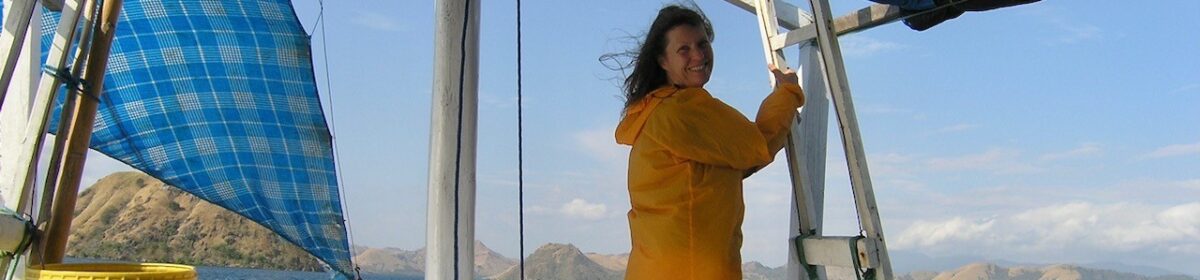
Just Another Day in Paradise. – Bartolome Island


Thursday, July 9th. Just Another Day in Paradise. – Bartolome Island

We have a 6:00 A.M. wake up call so that we can be on Isle Bartolome before sunrise. Shortly after 7:00 A.M., we make a dry landing on the island, but the morning is heavily overcast and the sun has already risen. Nevertheless, the hike to the top of the mountain is enjoyable and the classic view of Bartolome Bay, with “Shark Tooth” rock jutting skyward, is beautiful. We have our snorkeling gear with us and following our hike, we snorkel from beach. It’s another exceptional snorkeling experience and we swim slowly around the outcropping rocks to a sheltered area abundant with colorful fish. Many hundreds of disc shaped steely blue-grey fish with brilliant yellow tails, school together. They hang suspended in the clear water, undulating with the current. A variety of colorful parrot fish, solitary swimmers, two to three feet long, munches on the coral, their crunching sound amplified underwater. I am alone in a sheltered cove when a dozen 18″ penguins torpedo past me. They startle and delight me but are gone in an instant. John’s gills are now fully developed and I watch him dive repeatedly; ferreting out more unusual fish 15 feet below the surface. Richard has taken a liking to John and they have been exploring the reefs together, two sets of flippers simultaneously disappearing below the surface. Richard is Tara’s and Nicolai’s father, an extremely lithe and fit man in his mid to late 40’s and this informal buddy system eases some of my concerns for John’s safety.

Just before lunch, we motor to La Baltra Island for refueling. The plan is to have lunch during the refueling process, but we arrive later than expected at the dock. We are not allowed on deck during this process, so linger at the dining tables, watching. Later in the afternoon, we have a dry landing on north Isla Seymour. Once again we are greeted by marine iguanas, but the highlight of this island are the land iguanas, There are several thousand on this island and it isn’t long before we spot our first golden beauty. They are large and meaty; their skin, variegated colors of burnt umber, yellow and gold. The jeweled scales atop their heads are nubby, like kernels of corn on a dried husk in rich harvest colors. We spot these solitary lizards, poised atop rocks or sheltered underneath the bare branches of scrubby bushes. They sit aloof; head regally raised, gazing straight ahead, their thick front muscular legs supporting their weighty chest and thick neck. For the most part, they are not disturbed by our presence, but when one tires of our attention, it quickly lumbers off on thick legs, its tail undulating back and forth in the classic lizard walk. There are blue-footed boobies and frigate birds on this island as well. The mating season for the frigate birds is later here and we are privileged to see many male frigates, their throat sacs inflated a brilliant red, striving to attract a female.

Art and I arrive at dinner a few minutes late and find ourselves sitting alone at the captains table. I am relieved that the captain does not make an appearance since I’m not sure that he has a second tale to tell his guests. Most of our group watches Master and Commander after dinner, an appropriate choice since much of the movie takes place in the Galapagos. We dock in Puerto Ayora for the night and spend a peaceful night gently rocking in port.

Isla Santiago – Blue Grotto

Wednesday, July 8th, Isla Santiago – Blue Grotto

The intensity of the past two days has been overwhelming. The diversity and abundance of species boggles my mind. This morning’s excursion is to Isla Santiago where we see a different species of marine iguana; slightly smaller and with a reddish colorings. The topography of the island is striking and black lava beds slant into the ocean. The ripple patterns in the lava are beautiful and wave and wind action has worn away layers of tuff and carved deep grottoes into the rock. We peer down into the cave like grottoes; the bottom of the pools an intoxicating turquoise, and see fur sea lions basking on exposed rock ledges. We walk across the natural bridges spanning the grottoes and wish that we could snorkel in these amazing pools. Apparently it used to be allowed, but the fur sea lions moved to different basking spots, so the grottoes are now for the exclusive use of the sea lions and sea turtles.

During lunch, the boat motors to and anchors off shore of Chinese Hat; a small island, aptly named for its shape. The pangas drop us at the inner, sheltered cove and we snorkel slowly back, along the rocky shoreline. I am delighted when a marine iguana swims past, and follow him briefly until he clambers from the water to bask on the rocks above. A 5 foot white tipped shark rests on the sandy bottom; difficult to discern until John swims downward, disturbing it’s rest and it swims away. Colorful wrasse and humorous blennies frequent this tidal zone. The blennies hide in protected holes and crevices, poking their heads out, their bulbous eyes ever watchful, ready to withdraw at the first sign of danger. John spots black and white spotted puffer fish wedged in a rocky crevice and Art and I witness as he grabs it’s tail and tickles it’s belly. Startled, it inflates and swims off with indignity to find a new crevice in which to hide. The visibility is superb and John continually dives down to peer under ledges and into crevices; A large lobster stares back at him from under a rocky ledge and John grasps it by it’s feelers and try’s to dislodge it. The lobster resists and John gives up the challenge. I already see subtle evolutionary changes in John; gill slits are beginning to develop and I notice webbing forming between his toes and fingers; most remarkable!

Tonight is our obligatory dinner with the captain. All of the other passengers have already had the privilege of dining with him. Last night, the three hearing impaired women were his dinner companions and Kath signed rapidly through the whole affair. Her hands were so busy that she had little time to eat. The three of us, plus Laura, (Kath’s daughter,) now sit at the large table and wait for the captain to arrive. He is a man in his mid 40’s with just one story that he tells to all of his guests. Years ago, when he was in the coast guard, he spotted a “ghost ship,” without its lights. It was an illegal fishing vessel, but ultimately, there were many tons of cocaine stashed below the frozen, illegal tuna. Apparently, this event made his career and he tells the story, night after night to all who grace his table. I am grateful that he has an interesting tale to tell and we are not forced to simply make small talk. Therefore, we enjoy his embellished tale, the good food and the wine that accompanies the captains table.

Land Before Time – Fernandina Island


Tuesday, July 7th – Land Before Time – Fernandina Island

We make a dry landing on Fernandina Island, disembarking onto wet lava rocks, slippery with seaweed and the morning tide. Hundreds of marine iguanas are there to greet us and John and I are mesmerized by their presence. We were on Fernandina Island 5 years ago, and know what to expect, but the presence of hundreds of these aquatic lizards is amazing. These are the biggest of the marine iguanas, black and meaty, some nearly 4 feet long. Several lone iguanas graze on the velvety green seaweed exposed by the low tied. They turn their heads sideways, scraping at the close-cropped seaweed with the sides of their mouths. Barnacle like protrusions grow from the tops of their heads and raggedy grey and black spines adorn their backbone. The iguanas sneeze frequently, expelling the excess salt from their nostrils and through a third hole at the top of their heads. Iguanas are swimming off the rocks, heads held high, their spiny tails undulating back and forth, propelling them forward. They submerge to graze on the silky beds of seaweed below the water’s surface and clamber awkwardly up onto the rocks to bask in the morning light. We walk slowly and carefully towards shore, mindful of the treacherously slippery footing beneath our feet. Piles of marine iguanas bask on dry rocks near shore, seemingly in affectionate groupings, but more likely, just sharing body heat. Each grouping of iguanas is more fascinating than the last and John and I lag behind, observing and taking endless photographs. The terrain is breathtakingly stark. Slabs of black lava, the flow patterns frozen in time and sculpted by the wave action slant down to the ocean’s edge. Shallow, sand filled, turquoise blue tide pools are contrasting jewels in the black lava landscape and brilliant red crabs scurry along the rocks, darting into holes and crevices when we get too close. As much as the crabs are vermilion splashes of contrasting color, the marine iguanas are camouflaged; black against black. More than once, I nearly step on a sleeping beauty, flattened upon the rock absorbing the suns heat from above and the radiant heat emitted from the rocks. The iguanas allow us to get within inches of them, to admire every crusty scale, sharp claw and ragged spine. For myself, these are the most miraculous and beautiful creatures on the planet and would our guide allow, I would curl up with a pile of iguanas and spend a delicious hour basking in the sand with these gentle, near prehistoric creatures.

Art carries the tripod and the gigi-pixil contraption and sets up and takes several panoramic shots during the mornings excursion. I see him from afar, tripod balanced on the lava, bending over the equipment, trying to capture the remarkable beauty of this place. An adjacent lagoon is host to a myriad of water birds and a lone eagle ray glides in the shallows, it’s wing tips breaking the surface of the water. Mangroves stand spider like, sentries of the shore and two large semi submerged rocks morph into aquatic turtles. Magic is present. We retrace our path back to our landing spot. The zodiacs are waiting but John and I lag behind, not yet ready to leave this enchanted island.

During lunch, we sail to Isla Isabella for deep water snorkeling along the cliffs. Our pangas take us from our boat to the sheer wall of rock where this part of the island meets the ocean. My initial plunge into the water takes my breath away, but the cold water entering my wet suit is soon forgotten when I spot a green sea turtle just below me. The turtle is undisturbed by my presence and grazes placidly on the algae growing along the cliff’ walls. Sunlight streams down illuminating her carapaces a velvety green and she moves in slow motion, undulating with the ebb and flow of the current. Huge sea star jewels cling to the rocky wall; chocolate brown with brilliant orange knobbles catching the sunlight. Tiny brilliant red and purple wrasses take shelter in pockets and crevices along the rock wall and we see other sea turtles grazing, their strong armored flippers propelling them gracefully. They wear an eternal placid smile and stories of wise old turtles flash through my mind. We snorkel with the sea turtles for over an hour and later, John tells me that he caught a ride on one. He tells us that the turtles had different personalities; that some were shy but that one in particular, allowed him to swim underneath it, seemingly enjoying his company, and then allowed him to hold onto it’s shell and glide along with it. Touching the animals is absolutely forbidden, but I am unable to scold John. The magic of the hour-spent swimming with the turtles is something that I will remember always and John is fortunate to have made a closer connection. Earlier on, during our snorkel, John catches my attention and I swim towards him. He has circled back away from the group and points to a ledge several feet above the waters edge. Two flightless cormorants are beginning their mating dance. These silly birds have dis-evolved and have tiny useless wings that they hold away from their body to dry in the afternoon sun. They are sidestepping and cooing and soon the two birds plunge into the water, just a few feet away from us. They perform a most incredulous and undulating mating dance; craning their necks gracefully around the other’s and after two or three graceful twirls in the water, the male points his beak straight into the air, propelling himself vertically and emitting a breathy whistle. The cormorants continue in this fashion for several minutes and we watch, fascinated and amused. I surmise that they will continue this ritual for some time and although I wish to watch the finale, the sea turtles lure me away.

We motor back to the boat to shower and change but return in the zodiacs for a final, late afternoon cruise, further along the vertical cliff. The magic of the day continues when we see the small Galapagos penguins roosting on slanted slabs of rock, thick with white guano, dipping into the ocean. There are less than a dozen birds and half are rather scruffy looking, in the midst of molting. They stand with their backs towards us, absorbing the heat of the late afternoon sun. The molting penguins do not swim, but two or three of the other penguins, side step down the slanted rock and shoot like a miniature torpedoes, into the water below.

For the Birds; Boobies and Beyond – Geneovessa Island


Monday, July 6th – For the Birds; Boobies and Beyond – Geneovessa Island.

The general wake up call is at 7:00 A.M. and I lie in bed a few minutes, listening to the faraway clatter of the staff setting out our breakfast. Strong coffee and an ample breakfast buffet await. During the night, we have sailed to Darwin Bay on Isla Geneovessa and we board the pangas at 8:30 for our morning excursion to the island. It is a wet landing on white coral sand and red-footed boobies, nazca boobies and frigate birds are all there to greet us. We split into two groups of 10, the three of us following Delores along the sandy trail. There is little green on the island, most of the bushes and small trees are barren of leaves; their twiggy branches silvery in the cool morning light. Mating season is over and many of the birds are nesting with show white fledglings in their nest. A cloud of white down is an ethereal halo around the blue beaked baby boobies. The boobies build nests in the scraggly trees along side of the trail and have no fear of the two-footed visitors. The comical boobies seem to enjoy the attention from the tourists, turning their heads to offer their best profile and proudly preening their babies in our presence. The birds seem to make eye contact with us and we watch adult boobies, feathering their nests with twigs; seemingly asking our opinion concerning where to place a twig in an existing nest, or if we approve of their proposed nesting site? We enter into a thicket of leafless trees, popping out into a clearing populated with hundreds of frigate birds. A single male sits atop a barren branch, the pouch beneath his neck fully inflated and cherry red; hopeful of attracting a mate. He seems to have arrived at the dance too late. Dozens of frigate birds are already nesting, but they build platform nests and although we see many fluffy white fledglings, we also see nests with broken eggs below. These are the great green frigate birds and their black plumage is an iridescent green in the sunlight. The birds squabble over the privilege of sitting on a nest and the clusters of frigate birds with their hooked craggy beaks, are reminiscent of crotchety old men. The fluffy white frigate fledglings already have the black hooked beak and face that only a mother or father could love. This island is also a nesting ground for nazca boobies and swallow tail gulls and all seem to be living together harmoniously, completely undisturbed by the strange two footed species with a rotating black Cyclops eye that frequents the trails in clusters of ten.

Upon returning to the ship, we are greeted by Hugo, standing formally with a tray of hot cheese hors d’oeuvres and pouring fresh juice for all of us thirsty birdwatchers. Lunch is served at 12:30 P.M; a bowl of hot soup followed by a hot buffet, accompanied by several delicious side salads.

Our afternoon excursion is to the Prince Phillips steps; a dry landing at the bottom of a short cliff with rocky steps carved up to the top of the cliff. The contrasting colors of the orange and black rock against the azure water are striking. We take a short hike to the far side of the island where hundreds of frigate birds catch thermal wind currents, circling above the cliffs, protecting their nesting ground from predators. Their flight activity is intense; their angular black silhouettes darting across the grey sky. This wind swept section of the island is quite barren except for a low, creeping ground cover and a few hearty lava cacti.

Back on board, we are again greeted by Hugo with another selection of hors d’oeuvres and fresh juices. Many of us gather topside to enjoy the warmth of the fading afternoon sunlight, a drink and the spectacular view. Art and I recline on two of the thick blue foam chaises and John, having quickly made friends, sits across from us, playing cards with the other teen agers. We sink into the magic of this perfect hour.

There is a 6:00 P.M. briefing on tomorrow’s activity schedule and our ship has begun to rock and roll. This evening we will cruise 16-hour cruise to Fernandina Island and we are warned of rough seas ahead. I am determined not to be sea sick, but several of the passengers have already succumbed and I notice that Art is looking slightly green. Earlier today, the kitchen took orders for dinner, and I know that garlic shrimp will be served tonight, which, in spite of the rough seas, still sounds good to me. Half of the passengers are missing for dinner, but John and I enjoy big and juicy shrimp. Art sits with us, nibbles a few bites and returns to the cabin. It is a rough night at sea but I sleep well and have intense dreams of being at sea and the ship free falling from the crests of the waves into the troughs.

The Unfolding of a Darwinian Adventure


Sunday, July 5th, The Unfolding of a Darwinian Adventure.-Quito to San Cristobal, Galapagos.

Our wake up call is at 5:30 A.M. I’m always the first in the bathroom, followed by Art and then John. We did most of our repacking last night so the morning is not stressful. We eat a light breakfast in the hotel and Antonio picks us up promptly at 7:00 A.M. I have allowed too much time for check in and Art and John let me know that they would have enjoyed an extra half hour in bed, but we are all in good spirits and board our AeroGal flight to San Cristobal Island precisely on time. We will be on the ship the Eric and the three of us are wearing sticky plastic Eric buttons. We discretely look at other passengers buttons to see who our future traveling companions might be, but it isn’t until we land in Guayaquil and disembark so that the plane can be refueled, that we find others wearing Eric buttons. The first family that we meet is from Maryland; a couple with two daughters; 15 and 17. They are traveling with two other women and a 15 or 16 year old girl. All three of them are hearing impaired and are rapidly signing to each other. It looks as if an extra dimension has been added to our Galapagos adventure and I hope to learn some basic signing on this trip. We re board our plane after the refueling for the second leg of our flight. Before landing, the flight crew opens the overhead baggage area and sprays either a bug spray or disinfectant into each compartment. The compartments are quickly closed for the remainder of the flight, apparently so that the spray can do it’s job. It is 11:15 when we land on San Cristobal and we are the first ones of our group to disembark. When we reach the bottom of the stairs descending from the plane, our hands are sprayed with a mild disinfectant and we notice that all the airport staff are wearing protective masks. We have prepaid the $100 per person entrance fee to the Galapagos and our entry cards are quickly stamped but we are required to wipe our hands with a provided, alcohol towelette and our carry on luggage is inspected. I surmise that these precautions are for the health of the airport staff, not for the protection of the wild life. Upon exiting the open air terminal, we are met by our two guides, Alexis and Delores. In spite of the stringent health precautions, there is a sense of informality and serenity at this airport. John and I look for lizards outside the terminal and immediacy spot three small green striped lava lizards doing push ups on sunny pink lava boulders,

When the rest of our group is through customs, we are herded onto a waiting bus for a short ride through town to the San Cristobal dock. Playful sea lions lounge on the walkway leading down to one of the landings. We don our life vests, climb into one of two waiting zodiacs and motor out to our waiting yacht, the Eric. We are helped aboard and ushered into the spacious, mid deck, lounge area. The 20 of us sink onto a u- shaped lounge seating area and await further instructions. The Eric is solar and wind powered and basic safety and conservation issues are explained to us. We are assigned cabins and descend one level to the Iguana deck; to cabin number 10. It is a triple and although not large, certainly adequate for the three of us. We spend the next hour unpacking and getting settled in our new nest. There are two bunks against one wall and John chooses the upper birth with portholes overlooking the surface of the water. I have the single birth on the other wall. There is a long shelf above my bed where we stow our empty suitcases, having placed our belongings in drawers underneath the lower beds and utilized the closet. Our efficient bathroom has plenty of shelving and a spacious shower. I’m anxious to get under way, but the boat remains anchored in the harbor and a considerable time elapses as we wait for the expected siren to practice the required emergency drill. Eventually we are informed that the P.A. system has shorted out and we practice the drill on the top deck, sans the siren and then set sail.

Our first excursion is to a sandy cove not far from the town of San Cristobal. We pre-ordered wet suits in our sizes, but when we try them on, the sizes are all wrong. We sort through the rack of wet suits at the aft of the boat until we are more or less suited up. We have brought our own masks and snorkels, but use the fins provided by the boat and stuff all of our gear into the provided mesh bags. It’s just a short ride in the zodiacs to the sandy cove but there are already several boats anchored there and we must share the beach and the snorkeling area with close to 60 other visitors. Dozens of Galapagos sea lions lounge on the white sand beach, undisturbed by our presence. One nursing female scolds her two pups as they nuzzle her belly in search of a tit. The pups are hungry and persistent, but mom must be tender and she complains loudly when they nurse. Other sea lions bask in the afternoon sun; eyes mostly closed and a dusting of golden sand sticking to their chocolate colored skin. I awkwardly follow others of our group into the water, walking backwards wearing my fins and struggling to adjust my mask and snorkel. I feel the sudden flow of cold water into my wetsuit, inhale and put my mask into the water. The sandy bottom has been stirred up and the visibility is awful. I see little except for the floating orange filaments of sea lion excrement but I continue swimming towards the rocks in hopes of better visibility and an abundance of fish. I spot a few large parrot fish and the smaller fish gleam in the afternoon sunlight, but there is considerable surge and after a few minutes, I swim to shore to spend time with the sea lions and explore the area on foot.
When I turn my attentions inland, I see half of a rainbow suspended over the extra-terrestrial landscape beyond. The pangas return us to the ship; we rinse out our wet suits, take short showers and at 6:00 P.M. we meet in the lounge for a briefing of tomorrows schedule. We are ceremoniously served an overly sweet and very green welcome drink and are introduced to the crew of 11. Dinner is immediately following; a lovely white fish accompanied by many salads; nearly half the passengers are vegetarians.

Hacienda Pinsaqui Otavalo market


Saturday, July 4th – 9:00 A.M. breakfast at the Hacienda. Bus into town. Fabulous Otavalo market on Saturdays. Lunch at chicken place. I’m still sick. Get stomach antibiotics at pharmacy. Antonio picks us up at 3:00 P.M. Drive back to Quito through fabulous dramatic highland landscape. Arrive in Quito just before 6:00 P.M. Frantically figure out morning flight to Galapagos. Call my father and get manicures and pedicures.

Pappallacta to Otavalo


Friday, July 3 – Antonio picks us up at 10:00 A.M. Drive to Otavalo. Arrive at Hacienda Pinsaqui at 2:30. Fabulous old hacienda with gardens. Our room lovely, with fire place. Take bus into Otavalo and wander the town. Late lunch of burritos and chicken wings. I’m still sick…ache, diarrhea, stomach pains. When we arrive back at the hotel, our fire has been lit. Welcome drink at Hacienda, Ecuadorian musicians. Dinner in lovely formal dining room with fireplace. Return to the room to find hot water bottles in our beds. Fall asleep to the fire. I’m still sick.