Luxor Unfolding

It is nearly 11:00 P.M. when I arrive at our hotel in Luxor and Stephanie is relieved to see me. She knew that I was determined to go into Cairo on my own and has been slightly worried. We walk up to the roof top of our hotel and catch up on the days events before turning in for the night.

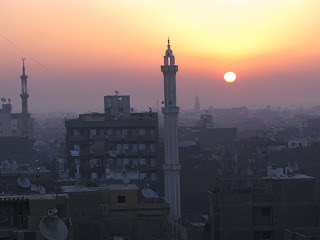
I am awakened from my short night’s sleep to the morning call to prayer. In my mind it is the hotel’s clever wake up call and I believe it to be 6:30 A.M. I get up quietly, only to discover 15 minutes later that it is only 5:00 A.M. I try to go back to sleep but am unable to drift off. Another call to prayer echoes in the grey dawn and I get up, tiptoe out of the room and take the elevator to the rooftop. I am still wearing my sleep t-shirt and my Bali lounge pants and I am a little embarrassed to find two other sunrise watchers already there. The Moser Hotel is 8 stories high and I look down on the flat roof tops of the surrounding buildings. Hundreds of dirty satellite discs, all with their faces raised to the satellite god, stand sentry on the rooftops. Skinny forlorn dogs wander amid the debris and trash that is scattered upon the rooftops. The unremarkable skyline is defined by several skinny spires and a salmon glow warms the dirty haze. A sliver of the sun pierces the grey and soon an orange ball floats fully round on the horizon.

Breakfast is at 7:00 A.M. and the weak coffee and sticky white rice and beans are less than appealing. I pass on the platefuls of pastries and wait in a long and inefficient line for a greasy omelet. Gary Young, the CEO of Young Living holds an orientation meeting and the 108 of us are divided into three groups, and then smaller groups of 10 each. (Unfortunately, the tour group has grown from 60 people to over 100.) We are identified by name tags and color coded cords. I hang my red corded name tag around my neck and join the red group on bus number 3.


Turkish Coffee and Hookhas


As we drive towards the Khan-al Khalili, Ernesto asks if I would like to drink some Turkish coffee and smoke a water pipe? I tell him that that I would like that and he tells me that it will cost about $20.00 I tell him that I am out of money which is the truth, since I have only exchanged one hundred U.S. dollars. Between the $40 paid to the taxi kiosk in the hotel and what I have handed over to Ernesto for entrance fees and parking, I am tapped out. He contemplates that and we eventually pull over on a side street in the crowded Islamic district. He passes a folded bill to a man who takes the car and parks it at a tilt in an impossibly small space. I worry since my computer is in my back pack upon the back seat, but since it is broken and I don’t want to carry it into the souk, I trust to fate. The old souk is colorful and small open shops line the narrow passages. Cheap goods spill out into the walkways. Brass and tin lamps, pitchers and tea sets are crammed into tiny open shops. Other shops sell brightly patterned wall hangings, woven rugs and and tapestries. There are book shops as well as the usual array of cheap t-shirts and tourist junk. Some of the narrow walkways are paved with ornate Islamic tile and others with small cobble stones. There are many cafes in this district and Ernesto chooses one just off the main passageway and tells me he will treat me to the coffee. We sit across from each other, a small brass table between us. He orders two Turkish coffees and an apple flavored water pipe for us to share. Another man sits alone at the table beside us and it is instantly obvious to him that I am a tourist. He speaks to Ernesto in Egyptian and then to me in English. I learn that he is American and a distributor of water pipes within the U.S.A. We are served the Turkish coffee and it is thick, sweet and strong. The waiter next brings the water pipe and sets it on the floor beside our table and takes two sterile mouth pieces from sealed plastic wrappers and attaches them to the pipe. The American has determined that I am a novice and advises me to just take a couple of puffs from the pipe. I appreciate his advice and cautiously draw on the pipe. The smoke is cool and tastes of apple. Ernesto and the American converse in Egyptian while I sip my coffee slowly and breath in the exotic landscape surrounding me. Ernesto finishes the pipe and goes inside to pay the bill. In his absence, the American tells me that Ernesto thinks that I am a stubborn woman. I imagine that something was lost in translation, and I surmise that the coffee and hookah cost only a few dollars, not the $20.00 that Ernesto was lobbying for in addition to the the money I had previously handed him. Upon returning to the car, I am happy to find my back pack with all its contents intact. The return drive to the hotel seems to take longer than before, but perhaps it is just an illusion induced by an overly full bladder.

Escaping the Gilded Cage


Stephanie and I wake at 6:45 A.M. and enjoy the hotels breakfast buffet. There are 4 flights to Luxor today and Stephanie is on the early one. My flight to Luxor leaves at 8:45 tonight, which gives me the entire day in Cairo. I simply need to escape the gilded cage of this luxury hotel. The powers to be on this tour seem intent on keeping us captive, and this morning, upon overhearing a woman in our group say that we are not allowed to leave the hotel, I slip away. There is a taxi kiosk within the hotel and I inquire about hiring a taxi and driver to take me into Cairo. Within 10 minutes, I have handed over $40.00 and am walking to the curb with Ernesto, my driver. He is 31 years old, handsome and I will learn that he is not as honest as his name implies. He maneuvers the taxi at break neck speeds through morning traffic; 45 minutes into the City. We slip in between lanes of cars with just inches to spare on either side. Horns honk and there are no distinct lanes. I reflect on morning drives to school with my 17 year old son John, and wonder which is the more stressful commute? Ernesto’s English is passable, and baring a traffic collision, I feel safe. He asks about my family and I regret that I don’t have photos of Alisha and Molly on my I phone. I do have photos of Art and John from our trip to the Galapagos and I share these with him. Ernesto uses his English, or lack of English to his advantage. He speaks of the entrance fees charged to enter the Citadel, the Mosques, and the cost of parking. He talked about the government shops and how their prices are fixed with no commission given to the guides; implying that he will give me a straight deal. I learn that there was an incident last night in Cairo and that there is protesting downtown that we must avoid. I am not interested in going downtown, unless it is to look for a computer shop, but decide that this will be impossibly complicated and dangerous. (not because of the protestors, but because I am certain that whatever computer decision I make will be the wrong one, and extremely expensive.)

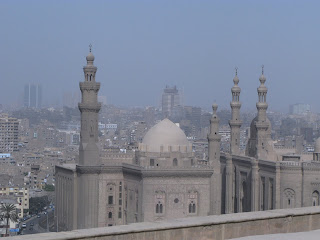
The cityscape on either side of our speeding car is punctuated with spires and domes silhouetted in the bright morning haze of this immense and smoggy city. Our first stop is the Citadel, a glorious mosque perched atop a hill overlooking all of Cairo. Its smooth dome reflects the sunlight and its spires reach skyward. Ernesto asks me for $250 Egyptian pounds, the equivalent of $50. He tells me this will cover all of my entrance fees, his half price entrance fees and the parking for the day. I immediately know that I am about to be taken and reluctantly hand over $300 Egyptian pounds (lacking exact change.) The entrance fee to the Citadel for a tourist is just $50 Egyptian pounds and I watch as Ernesto slips bas-shish (tips) to parking attendants and gate keepers throughout the day. He buys me a requested bottle of water and a mango juice that I don’t want. There is a $25 pound charge into one of the mosques, but in the end, Ernesto keeps the change, giving himself a substantial tip. I am hesitant to write this, since I know it is making Art squirm, but I let it go and enjoy the luxury of being out and about with a private guide. The view from the Citadel would be breathtaking if not for the pollution. I have packed a cut velvet scarf with beading at both ends and cover my head when we enter the mosques. The scarf seemed to meet with Ernesto’s approval and he adjusts it upon my head and smiles. He insists on taking photos of me every few minutes, assuming that this was what I want. I am eventually able to make him understand that I don’t want photos of myself in front of every landmark but wish to take my own photos of the mosques, their ornate grills and their beautifully carved doors. The Citadel is a walled complex of mosques and museums and we spend the better part of two hours there. At one back gated entrance, security guards question Ernesto at length before admitting us. When we retrace our steps, he instructs me to say that he is a friend of my husband, should anyone ask. We return to the car and drive into a Christian district. A locked gate swings open, money exchanges hands and we drive into a Christian cemetery, crypts lining the narrow dirt road. Children play in the road and women wearing Hijaabs (head coverings) and Abayas (traditional long dresses) walk the narrow dirt labyrinths between the crypts. I learn later, that many of these people live there, for shelter and to watch over the graves of their ancestors. We park and walk into a Christian compound with a church honoring Saint George and the Dragon. The area is not particularly picturesque, and I am amused at the crude contemporary paintings and mosaics of St. George and the dragon. Ernesto seems disappointed that I am not more enthused, but I am anxious to move onto the Khan-al Khalili, the market place in old Islamic Cairo.

Computer Malfunction

Last night, when I plug in my notebook computer, I hear a soft pop and a whine and the screen goes blank. I try several times to restart it, but it has suffered a brain aneurism. There is no green light when I plug in the charger, just an ominous yellow light. I am very disappointed that I will not have use of the computer during this trip and will have to write my blog when I return home.

Arriving in Cairo


It’s a long and grueling trip between Santa Cruz and Cairo, beginning on Friday morning, Feb 19th at 4:00 A.M. I have worked at warp speed for several weeks in preparation for this trip so that I might leave with a moderately clear conscience. We fly first to New York where we connect with many of the others in our group. The flight between New York and Cairo is 11 hours and I sleep relatively well on the flight. I am anxious to de-plane and immerse myself in another culture. Customs is the usual long lines of tired and disgruntled travelers and we need a visa to enter. Our guide is to have pre-purchased all of our visas, but he is out of sight beyond the immigration area and we strain to see past the exit gates. Eventually, we spot a man holding up a Young Living sign, obtain our visas and pass through immigration. We wait impatiently for our bags to appear on the luggage carousel, but all eventually arrive and our guide gathers his flock of weary travelers. Names are checked off of a master list and when we are all accounted for, we are herded out of the terminal and onto the waiting busses. Dusk has fallen and the sky is a rusty indigo, the eerie color a result of the pollution. The atmosphere has a tactile grainy quality, but without the urban smell which seems contradictory to the intense color of the sky. Our bus takes us three minutes to the hotel, but it is 10 minutes before we are allowed to pass through the hotel gates. Security guards check the luggage hold for bombs and drugs and when we disembark and enter the hotel, we walk through a metal detector and our bags are placed on a conveyer belt and x-rayed.

The Iber Hotel is a 5 star property, the glitzy lobby bustling with travelers. When we enter, an engagement party is underway and the well dressed guests mill around the curved staircase leading upstairs to the disco and restaurant. A troop of musicians descend the staircase and belly dancers gyrate to the Arabic music. The lovely young couple is elegantly dressed; she in a form fitting red dress, and he in an expensive suite. The party soon ascends the staircase, retreating into a private dining room. Our Rooms are assigned, but Stephanie and I are not on the room roster. This is resolved shortly but my hopes of going into Cairo for dinner are shattered. Our hotel bubble is nearly an hour from the heart of Cairo and the powers that be seem intent on keeping us confined in our safe bubble. We partake in the elaborate buffet dinner; meet our fellow travelers and retire to our room.


Preface to The Frankincense Trail

Several years ago, I was introduced to Young Living Essential Oils by my friend and acupuncturist, Stephanie. In late January she called to ask a jewelry question and in the unfolding conversation, I learned that she was contemplating a trip to Egypt and Jordan with Young Living. I encouraged her to go, and in the ensuing conversation, I became interested in joining in on the adventure. I was scheduled to fly to Tucson in just two days and needed to make a decision on the Egypt and Jordan trip before I left. For those of you who know me, travel is an addiction of mine, and I ran the scenario by Art that evening. He took the news in stride and by the following afternoon, I was ticketed and signed up for the trip. It was a large group going; some 50 or 60 people, and I am not found of large groups, but Young Living was filming a documentary on the Frankincense Trail. The filming would take two or three days, and take place in the desert outside of Cairo with a caravan of camels. They needed camel riders and camel leaders to recreate the caravan scene and it was the camels that most enticed me. The itinerary included the usual visitations of temples, sphinxes and pyramids in Egypt, plus three nights in Jordan where we would have the opportunity to visit Petra.


Paradise Lost – Isla San Cristobal to Guayaquil


Monday, July 13th – Paradise Lost – Isla San Cristobal to Guayaquil

During the night I hear soft rain on the tin roof of our harbor side bungalow. I’m sure that it has rained most nights on our Galapagos cruise, but our cabin was on the bottom level and the noises of the ship masked the weather above. Although I wake before dawn, I cat nap and enjoy the luxury of a leisurely morning without a scheduled wet or dry landing. We leave John sleeping and Art and I walk the short distance into town. Sea lions grunt as we pass them along the beach and the red crabs are already scurrying upon the harbors black lava retaining wall. We choose a local open-air cafe, order our cafe con leche and huevo rancheros and wait for an extremely long time before our breakfast is served. We are on island time and I try not to be impatient as I gaze along the sleepy malacon and watch the boats rock in the harbor. Eventually, fueled with cafe con leche, we return to our bungalow to pack, wake John and return to our “slow food” cafe so that John can eat breakfast.

The airport is just a few minutes from town, but the check in process is inefficient and we wait over two hours for our plane to depart. An ambulance waits on the runway and our plane will transport an accident victim to Quito and we watch and wonder what might have happened to this unfortunate man. Our two-hour flight to Guayaquil is non eventful. We land just before 4:00 P.M and take a $5.00 taxi ride to the Grand Hotel Guayaquil in the center of the city. The Grand Hotel is not very grand; but they do have our reservations and give us vouchers for welcome drinks at the Turtle Bar and for breakfast the next morning. The obligatory bellhop delivers our bags our room and we immediately leave the hotel to explore the city in the short time remaining. Our first stop is the park directly behind our hotel where John and I remembered seeing iguana’s on our previous visit five years ago. The small square has a wrought iron gated perimeter, the 4 gates wide open on this lovely warm afternoon. Climbing the abundant trees and basking on the warm walkways are dozens of iguanas. The smaller ones hang from the trees, but alpha males sprawl beside the park benches and tolerate the attention of humans. Many are incredibly beautiful, with moss green heads, morphing into golden bodies. The ample folds of skin around their necks have intricate scale patterns and John and I admire, pet and photograph these remarkable creatures. After a week of not being allowed to touch the iguanas, we enjoy this close up encounter. Some of the older iguanas are war veterans of this environment; one missing a foot and many missing parts of their tails. The traffic whizzes around all four sides of the park, but survival instinct and the wrought iron gates keep most of the iguanas in their designated area. Mucky cement feeding dishes are positioned throughout the park and we watch one iguana wade through a disgusting dish of mashed fruits and vegetables. Art is impatient to walk to the malacon, so John and I tear ourselves away from our lizard friends and leave the park. As the light turns green we hear a loud crack, almost like a gunshot. We twirl, startled, and see an iguana sprawled behind us on the sidewalk and I fear that a car has hit him; John mutters, that guy is “buckled.” Turning back, we realize that this veteran male has not been hit by a car, but has fallen from the tree some 40 feet above us. He lies stunned, but miraculously sorts out his legs and tails and ambles off the sidewalk, squeezing through the bars of the wrought iron fence and disappearing into the foliage within the park. I wonder and worry how often this must happen, if he was pushed by another alpha iguana, or simply slipped.

We walk through the business district, past classical government buildings with ornate glass arcades. and monuments commemorating Ecuadorian independence. The afternoon light is lovely as we climb the steps up to the modern malacon; a raised expanse of concrete and stainless steel, curving along the waterfront. An impressive three mast sailing ship is permanently stationed here, a training vessel for the Ecuadorian navy. We walk along the malacon for some time, stopping to gaze at the wide and muddy river. Organic debris is trapped beneath the pylons to the pedestrian bridges and I imagine gargantuan, natural rafts composed of organic matter, transporting a pair of iguanas to one of the Galapagos islands and the evolutionary process that ultimately unfolded. Having just witness the resilience of the sky diving iguana, I find these theorized, incredible journeys all the more plausible. We leave the malacon and cross back into the city, finding ourselves in a labyrinth of tiny shops and street vendors. I clutch one strap of my back pack tightly as we wind single file through the crowded alleyways. Hawkers call out to us every few steps, holding out name brand copies of Nike, D & G. Pirated DVD’s are crammed into tiny stalls and a slinky young woman, in too tight jeans and a haggard face does her best to lure Art into a side alley. He sidesteps her multiple times, but she is persistent and we veer off the main corridor and find ourselves surrounded by a sea of shoes, stretching as far as we can see. Every few steps, one of these merchants points to my sensible sandals, dismayed at my lack of style and asks hopefully if I would like a more fashionable pair. We leave the bazaar and head back towards our hotel. It is nearly 7:00 P.M. and many shops are closing for the night, shuttered tight with roll down steel doorways and grates.

Back at the hotel, we redeem our welcome drinks at the uninspired Turtle Bar. John and I wish for a memorable last dinner in Ecuador, but we feel restricted to the hotels restaurant; the armed guards at the door, an indication that we may not wish to wander the streets at night in search of local fare. The ambiance of the 1822 restaurant is encouraging, but the permeating smell of chlorine, wafting in from the pool, and the lack of other patrons should have forewarned us. Nevertheless, we order a creamed seafood and cognac appetizer, which is entirely too fishy; two other entrees and a salad. All but my shrimp salad is mediocre and we are disappointed with our last hurrah.
The End of the Road


Sunday, July 12th. The End of the Road

We have our usual 7:00 A.M. wake up call and gather mid deck for our final breakfast together. There is a flurry of last minute e-mail exchange and the flash of cameras before we leave our floating home and are dropped at the San Cristobal dock. Our family will spend one night in San Cristobal and there is some confusion as to how our suitcases should be tagged since we are the only ones not flying out today. Alexis is curt with us; I believe because we are not well-behaved sheep following his departure schedule and after the perfunctory goodbyes, we leave to find our hotel. Our early morning stroll through this small sleepy town is pleasant but when we arrive at the supposed site of Hotel Galapagos, it no longer exists. Happily, our suitcases are dropped off, simultaneously to our arrival and with the help of the driver, we find that we are booked at Hostel Galapagos, not Hotel Galapagos. A short taxi drive delivers us and our luggage to the correct hotel, but they have no record of our reservation so, we simply pay the $70.00, resigned to simply sort things out when we get home. We are given two adjacent harbor side bungalows. The rooms are very simple but open onto a stone patio, with steps down to the sand and rock sea wall beyond. It’s a very short walk into town and we find our group having coffee at an outdoor cafe. John immediately joins in and plays a final round of cards while Art and I peruse the nearby tourist shops. After the glitch with the hotel, we decide to accompany our group to the airport and reconfirm our flight out for tomorrow. Alexis helps us at the counter and he is as relieved as we are that our tickets are in order.

I’ve choreographed most of the trip and today is Art’s day to plan the agenda. He wants to rent bicycles and explore the island and I am looking forward to the ride. Renting the bicycles is easy and at the suggestion of the bike rental office, we hire a taxi to drive us up to the hillside town of El Progresso. We will ride to Junco from there, which we anticipate to be mostly downhill. Perhaps we misunderstand the drop off point, but the ride turns out to be a seemingly endless uphill climb. We ride and push our bicycles along a deserted highland road. Mist hangs heavy in the air, and the ribbon of roughly paved road ahead is shrouded in a cloud, giving me the hopeful illusion that a town must be just around the next curve. We continue uphill for two hours. Art continually checks back on us, concerned that John is hungry and that I am tiring. I am determined to remain in good spirits, and I am intrigued by the sense of the unknown; but eventually, we all begin to wonder if we will ever arrive at civilization. We come to the turn off to the Junco Lagoon, the only freshwater lagoon on any of the Galapagos Islands. The two taxis that passed us an hour earlier wait for their passengers to return from their hike up to the lagoon. Although we have come this far, we don’t climb the mountain to the lagoon since we have no way to secure our bicycles and even Art is getting tired. In broken Spanish, Art asks the drivers how far it is to the next town. It is just 8 more kilometers and all down hill, so we decide to continue and return in a taxi. John speeds on ahead and when we catch up to him, some 30 minutes later we find him sitting in a village cafe, sipping on a coca cola and eating an empanada. He looks completely comfortable in this local restaurant; his feet up on a white plastic chair, watching Ecuadorian T.V. Art and I collapse into adjoining plastic chairs and order the chicken and rice which a local woman spoons from a large kettle simmering on her stove. The empanadas are heavenly; deep-fried, stuffed with a mild cheese and dusted with sugar. We are completely content, knowing that this destination could have never been choreographed. Chickens scurry across the road between the restaurant and a local tin roofed sports stadium. It’s Sunday afternoon and the locals are playing a game of volleyball, their clothes and shoes stained red from the surrounding dirt. A group of woman sits at the only other table, friends and family of the two women cooking in the house. The village consists of little more than the stadium and this neighborhood restaurant. We watch the road for over an hour, hoping for a taxi, but the only ones that have passed have been packed full of people in the extended cabs as well as in the beds of the pickup trucks. (Most of the taxis on the island are pick up trucks with an extended cabs.) Eventually, we ask one of the women to call us a taxi but after considerable trying, she gestures that she gets no answer. The grey mist turns to rain, the volley ball game ends and the few spectators are leaving. The lone car in the village drives off and not a single car or taxi passes through. It is well after 3:00 P.M. on a Sunday afternoon and I’m now very worried that we will not be able to get back to the port and our hotel. John has a forlorn look and even Art is beginning to worry. It would be nearly impossible to ride the 8 kilometers back uphill in the drizzle and pending dark. We decide that Art may need to take a spot in the back of a community taxi, go into town and return for us later, a plan that doesn’t thrill me. 30 minutes later, another woman, who has been busy on her cell phone, finally communicates to us that she has reached a taxi and that it will be here in a few minutes. We are relieved and grateful when an empty taxi pick arrives. We load our bicycles in the bed of the truck, pile inside along with a young girl and her brother and drive back along the misty road. It is 4:30 when we arrive at the harbor and return our bicycles and we joke that the misguided directions were a ploy of the bicycle shop to extend our rental hours.

The town is quiet on this Sunday night, but a few restaurants are open for the straggling tourists still on the island. We choose a simple restaurant at the far side of the malacon; an exercise in slow food and slow service; but we have no schedule and I reflect on the adventures of the day and the simple magic of this island evening.

Wave Riding Turtles


Saturday, July 11th – Wave Riding Turtles

This is our final day of our Galapagos cruise and our morning excursion is to Isla Espanola to see a different species of marine iguanas, nesting blue-footed boobies and albatross. Piles of large red and black marine iguanas lounge on the rocks near the landing site. They will become more colorful as mating season approaches, their legs turning a mossy green and the reds becoming more pronounced. We have arrived early to avoid conflict with other groups from a larger ship anchored off shore and I have plenty of quality time to spend with the iguanas. I take dozens of photos, each iguana seemingly more photogenic than the last. Most of the iguanas’ congregate together in piles, conserving their body heat and soaking in the morning sun but there are a few solitary iguanas, sitting perched atop rocks; Godzilla like figure heads, gazing out to sea. I am continually intrigued and delighted by these prehistoric creatures. The trail is rocky, uneven and slippery. We walk carefully along windswept cliffs splashed white with guano. It begins to rain making the desolate island all the more dramatic. Forceful surf rises up through a blowhole in the cliff below us; the water churning a frothy green, a stark contrast against the black and guano splashed cliffs. We come upon a windswept plateau with pairs of courting and nesting albatross. Their courting ritual is comical. They click their beaks together as if fencing flap their wings and return to beak clicking. We watch three albatross interact. Two are beak clicking, and a third one, saunters in sideways towards the courting pair. The dominant male rises up, squawking and infuriated and chases his competitor away. There are nesting blue-footed boobies and nesting albatross. Some birds sit on eggs while others preen snow-white fledglings. Some of the birds build nests adjacent to the trail and none of the birds are disturbed by our presence. We complete our island circle, returning to the “Land Before Time” where the marine iguanas congregate. I linger here as long as allowed, saying goodbye to my fantastic friends.

After lunch we have our final snorkeling adventure off a snow white sand beach crescent. There is a large outcropping rock some distance from shore and all of us swim out to circle the edifice. We haven’t encountered much challenging surf, but it gives me security to know that one of our zodiacs is waiting on the far side of the outcrop, should any of us run into trouble. The surf surges somewhat as I circle the far side of the jagged outcrop but it’s easy enough to maneuver and I swim towards John who is motioning to me excitedly. Taking his snorkel out of his mouth, he tells me that there is a white tipped reef shark below. I watch as John and Richard dive down to take a closer look. Disturbing the sharks’ afternoon nap, I see it swim off to find a more peaceful resting area. There are three sharks in this deeper sheltered area, each about six feet in length and apparently not a threat to us. Through most of our snorkeling adventures, my mask is in the water to observe the underwater wonderland below, but I periodically look up to orient myself in relationship to the other swimmers. When I next look up, I see that John has gathered another crowd and holds an inflated porcupine fish above the water. John submerges the fish and it struggles to deflate itself and swim back down to find a protected shelter on the sandy bottom. The puffer fish of the Galapagos will breathe a sigh of relief when John has left the islands. As we complete our circle of the rock, we see numerous needle fish, nearly translucent and swimming horizontally in the water. We’ve snorkeled almost and hour and motion to John that we should swim to shore. Having expended much more energy than I have, he is ready and we swim slowly back to the white sand crescent beach. Playful sea lion pups are swimming in the shallows as we wade from the water. The teen agers lounge on the sand, soaking up the afternoon sun and Art and I walk down the beach towards a rocky point. The fine white sand is like powder beneath my bare feet and sea lions and their pups bask on the sand, undisturbed by our presence. Art points to a shadow in the surf and tells me it is a sea turtle. I tell him it is a rock, but he persists in his sea turtle fantasy. A bit further on the rock rises to the surface, having morphed into an actual sea turtle and soon we see dozens of turtles in the waves. They are catching the waves and are back lit in the late afternoon sun; dark silhouettes of turtles, rising and falling with the surf. It’s a magical and almost unbelievable sight and although I have my camera with me, the moment I begin to video this scene, my memory card flashes full. So, my patient readers, you will just need to believe me and imagine this remarkable turtle sighting. We find out later that this end of the beach is a turtle nesting area.

It’s our final evening on the cruise and as usual, Alexis calls a 6:00 P.M. meeting to brief us on tomorrows schedule. Alexis has been taking photos of our group all week and has compiled a DVD of our trip. He lowers the blinds, puts on the DVD, and gives one to every family. After the showing, Art sees the blaze of the sunset through the lowered curtains and interrupts, suggesting that we all go topside to watch our final Galapagos sunset. Everyone abandons the meeting and I imagine that Alex was not pleased. His gift of the DVD was a nice one, but he was also setting the mood before handing out the surveys and tip envelops. The suggested tip amount is nearly twice, what the printed trip booklet recommends and we are somewhat confused. The final dinner of shrimp scampi and pork medallions is good, but not memorable; some of the other meals were better. It’s been a wonderful week, but I’m ready to abandon ship. .

Isla Santa Cruz – Lonesome George


Friday, July 10th. Isla Santa Cruz – Lonesome George.

We take the zodiacs into the port of Santa Cruz and are met by a small tour bus to drive our group up to the highlands of the island where we will see the giant tortoises in their natural habitat. The town has grown considerable since I was here five years ago and several three-story hotels have sprung up on the waterfront, blocking the view of the harbor. It’s early morning, but the many cafes are opening their shutters in preparation for the tourists that will flock to the town. As we drive out of town and into the highlands, the vegetation becomes lush and green. The morning is overcast and misty and we pass simple cinderblock houses and farms; the paint faded and worn and the red soil permeated everything around. Banana trees and trumpet flowers grow in abundance, their drooping, ivory colored, bell shaped flowers heavy with rain. Our first brief stop is to a lava tube and our group descends the slippery rock stairs into darkness, punctuated only by the occasional flash of some ones camera. As we exit, Alexis finds the light and the immense tunnel is illuminated. The tube is 15′ in diameter and extends for as far as we can see, but parts of it have collapsed and we retrace our steps back to the waiting bus. The bus turns down a hard packed dirt road and several people exclaim when they spot a giant tortoise in the farmland; an immense bump in the grassy fields. The tortoises are wild here and the local ranchers have a symbiotic relationship with them. Each day, multiple tour buses arrive with groups that traipse through their fields to get a close up look at these prehistoric creatures. This rancher has built an open visitors center and supplies rubber boots to the tourists in hopes that at the end of the visit, a drink, an ice cream or a postcard may be sold. We don our rubber boots and walk out along muddy paths into the fields. Several giants are at rest in the tall grass, their worn shells, glistening with moisture. Although we must stay a respectable distance from the tortoises, it’s not too challenging to take up close and personal photographs. Further, into the fields we come upon a swampy pond with three semi-submerged tortoises taking their morning mud baths. I have seen Franz Lanting’s photograph of the giant tortoises in a pond, mist gently shrouding their shapes. I presume it was taken in this same spot, but at dawn with the mist rising. I know that it takes much planning and patience to capture an exquisite photograph at the optimum time of day. We have plenty of time to spend with the tortoises but when we drive away in the bus, we are blocked by a lone tortoise dead center in the red dirt road. The bus stops and Alexis gets out and prods the tortoise underneath his tail until irritated, he moves slowly to the side of the road and we can pass.

Our afternoon visit is to the Darwin Research Center. This excursion is somewhat boring to me, but we meet lone George, the last surviving tortoise of his species and listen to Alexis drone on about his perceived breeding conspiracy theory. The pens of baby tortoises are very cute and John and I wonder what the penalty would be for tortoise napping. We later lean that we have an alternative and can purchase a giant tortoise for a mere $100,000. We walk from the Darwin center through town, stopping at numerous tourist gift shops in search of the perfect Galapagos souvenir, which apparently does not exist. In my many travels, it’s always disappointing, how limited the selection of good designs are. The Galapagos themed jewelry available is crude and uninspired and I fantasize about having a stylish jewelry shop here. We find an internet cafe, call home, and are relieved to know that all is fine at home.